Tower Fall
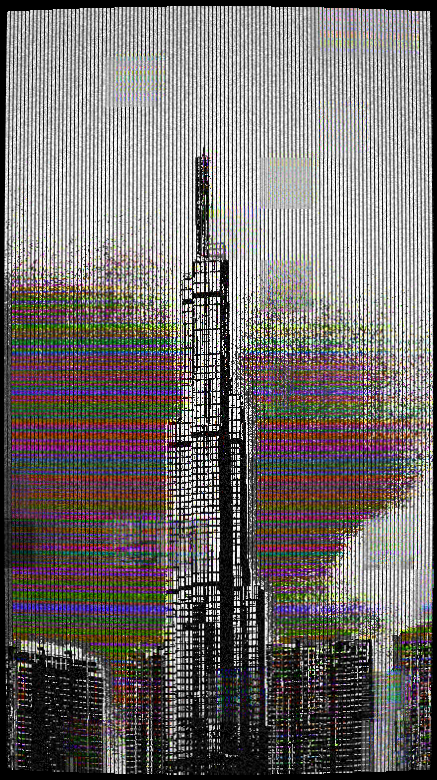
Großkopf had the fleeting sensation of crawling over the eight-foot sheet of glass as he and it exited the tower’s 205th floor. He had not expected the window to pop out in a single, unbroken piece when he impacted it, but that’s exactly what happened. His face hit the glass, followed by his chest and legs. Things seemed to tilt for a moment, and then he saw the side of the tower extend below him: gray steel and reflected night sky. Neon green, orange, yellow, and red blotched the low-city smog below him. Half a dozen towers pushed through like bright needles. The view was unlike any he’d seen before, despite having lived in the towers all his life. It lasted only an instant. Down-rushing plate met up-rushing air. The universe slipped into a spin. Großkopf pushed, desperate. The glass pinwheeled into the night.
3,552 feet. 25.3 seconds to impact, give or take 3 seconds.
“Fuck,” Großkopf said in response to Celine, his onboard AI’s assessment.
Less than a quarter hour ago he’d been dining in his restaurant, Chez, with a pair of sexy escorts he was pretty certain would let him fuck them together and would at least act like they enjoyed it. That was before a commotion had erupted at the bar between his plainclothes security detail and a stunningly beautiful woman in a brown, single-shouldered evening gown with a black-eyed Susan in her hair. Celine had erupted then, as it realized who the woman was, if not why she was there.
Run. It had flashed in its customary green letters on his heads-up-display. It was a strange command coming from Celine, but then came the unmistakable sound of gunfire, and even Großkopf’s drink-dulled brain put two and two together. He ran for the nearest exit: a seldom-used stairwell to which the AI directed him. He burst through the steel safety door, setting off a truly ancient alarm in the process, and started up the stairs toward his saferoom on floor 212.
Needless to say, he’d never made it to the windowless box surrounded by 18 inches of hardened, lead-lined steel.
In the moments before the assassin’s stim-augmented muscles had launched him toward the window, she’d whispered a name, as if it was supposed to mean something to him. Of course, it didn’t. But now that the freezing-fucking cold air was slapping his tie against one side of his face and threatening to untuck his fancy shirt from his overpriced, but goddamn comfortable pants, he kind of wished it did. Adrenaline coursed through his veins, kicking his mind into overdrive. There must be a reason his murderer had whispered it to him before hurling him at the surprisingly unstable window on the 205th floor of the second tallest tower in the city. If he could figure out what the name was and why the assassin had whispered it, maybe—just maybe—there was something they could work out, something they could do about this unfortunate fall.
22.2 seconds to impact, flashed before his eyes. Not much time. Not much time at all.
What was the name that woman said?
Aaliyah,Celine responded, fast as thought.
Aaliyah. A common name. There were probably a million women in the city named that. How to narrow it?
Images, he subvocalized. Pictures of every woman named Aaliyah I’ve ever known or interacted with. Now.
Faces rose before him, overlaying the colorful smog below. Brunettes, blondes, plump, slender. Faces memorable and forgettable. More than a few that he would’ve sworn he’d never seen before.
Faster.
A block of a dozen faces appeared before him, then whisked away so rapidly he almost couldn’t make sense of them. Another set. Another.
20 second, give or take—
Shut up. Go back one. He examined the faces more closely. There, in the center of the page. He couldn’t place her, but her thick, arching eyebrows, the sharply defined caret on her upper lip a black-eyed Susan in her hair… He didn’t know how he knew her, but as he examined her, he realized there was a certain similarity in her features to those of the woman who’d just thrown him out of a building. That and the flower.
In the middle. Black hair. What’ve you got on her?
Based on your eye motion, I assume you mean this one. The picture enlarged.
Yes yes yes. Hurry.
A datasheet sprang into the air before him. He skimmed it as rapidly as he could. Nothing jumped out as terribly important. She was a low status tower resident. Just above the tenement dwellers in low-city, but still a tower dweller. No criminal record. No notable achievements. She was one of those people who passed through the water of life without stirring a wake. In her case, hardly a ripple.
He spread his arms, doing his best to create drag and slow his descent. At what point would he hit terminal velocity? Didn’t matter. He’d be going much too fast to survive the impact. But maybe he could buy himself another second or two. Far below him, varicolored smog hid sprawling tenements and hovels. He’d never been to low-city himself, though his business interests extended into it. The mewling masses. The air was so polluted residents never ventured outside without re-circulators. A miserable existence. His acceleration pressed on his chest, threatening to tear the breath from him. He held the air in his lungs a little longer than usual before letting go. How precious, suddenly, his breath had become.
17 seconds, give or take—
Get the woman on the line. Now!
The line rang in the laconic, old-fashioned way of every call since the invention of the hand-crank telephone. For a moment, Großkopf thought it would be the last sound he’d ever hear. And then the assassin did what he’d been hoping, praying she’d do—she picked up.
Silence met him, and without waiting for an invitation he began. “I found her—Aaliyah—your mother or sister or—”
“Sister.”
“Sister. What do you want for her? Name your price. Anything. Just get me out of here. You’ve got a drone, a…a…big inflatable pillow or something—”
A dry chuckle cut him off.
15 seconds.
“She’s dead,” the assassin said.
“What?”
“And you’re responsible.”
“No. I’m a business man. I’m in real estate, not—”
“You are responsible. She was a tenant. First floor, very low in the tower hierarchy. You evicted her for noncompliance. She wouldn’t fuck you, when you asked. Dumped her in low-city.” She paused, but Großkopf was too stunned to speak. Hope drained from him faster than the smog-line’s approach. “Low-city’s not exactly a welcoming place if you’re not from there. The towers stir a certain…resentment.”
“How’d it happen?”
“Robbery gone wrong. The rest is in the packet.”
A little envelope icon appeared on his heads-up display. Open it, he subvocalized.
Ten seconds.
The first whisps of smog whipped past him. The scent of fuel oil filled his nostrils, then other smells more foreign to him: exhaust and ozone, cloying putrescence, woodsmoke and burnt rubber. His heart thudded. His shirt was wet; he wasn’t sure if it was from sweat or the thickening smog. His bladder loosed, soaking his expensive, goddamn-comfortable pants. He was going to die very soon, and there was nothing he could do about it. No talking around or worming out. There was no contract to void or license to revoke. He was hurtling toward the ground at astonishing speed and in the next few heartbeats he would strike, cease to exist. The tendrils of his life would extend into the world for a few more days, months, maybe years, he had to believe they would. What would become of his business? The escorts who, even now, must be waiting for him? They would all go on, but there would be nothing left of him. It was so fucking unfair. They got to keep on living, seeing the world, doing…things. He shook his head, screamed. He had so much left to do, so many loose ends flapping in the wind.
The video started. Großkopf only half watched it. How could he think about someone else with his own end so imminent? He couldn’t; not in any serious way. But the film played on, regardless of his wishes. The assassin had done something to Celine, had hijacked it somehow. Stop, he subvocalized, but the AI didn’t respond. The movie kept playing.
It showed the woman who looked like the assassin—Aaliyah—standing on a low-city street. Drones zipped just overhead. Dust and smoke clotted the air. Her clothes marked her: a flowing business gown, more than a year out of date, but still acceptable in tower society, and strangely, that flower in her hair. The people around her moved in trench coats, faded from weeks and months in the harsh air. Rebreathers covered their faces, anonymizing them by the buggy millions. She stood in the taxi queue with the more affluent of low-city, but even they gave her a wide berth. There was no love lost between tower dwellers and the teeming masses.
And then, quick as a lightning strike, a hand reached up, holding something heavy and dark that he couldn’t quite make out. She flinched and crumpled. The people around her remained still for a moment, then one ventured forward, tapped her shoulder. Nothing. A second followed. Großkopf couldn’t tell if she was dead or unconscious. The crowd seemed not to care. They stripped her of her gown, her purse. They carved the electronic implants out of the back of her neck. When they finished, she lay naked on the sidewalk, her chest barely rising. Taxis pulled up then, one after another, taking away those who had stripped the woman—Aaliyah.
The tape scrambled for a moment, as if badly cut, and Großkopf saw the woman lying atop a dumpster. An anonymous trash truck drove up and tilted the dumpster into its open hopper. Großkopf closed his eyes, but it didn’t stop the video. The lenses were implanted on his corneas. The compactor churned, the dumpster descended, and the truck drove off, a thin stream dribbling from a corner of its bed to puddle in the street.
It wasn’t his fault. He hadn’t pushed the button on the compactor or struck the woman senseless. He hadn’t even evicted her. People on the lower floors took care of that. He paid them to do so. He had built his life on the inevitable, on laws and practices shaped over time, on incentives and justifications. Maybe all of this—this fall and the garbage truck and the assassin—maybe these were all inevitable. Maybe they were the ends of long causal chains that drifted back into time’s smoky beginnings. Maybe all of the things that he had built and achieved led necessarily to this. How could he think otherwise? He was here, facing the end.
Something green flashed by and something red. He was fast approaching the end of all things, at least as far as he was concerned. There was an inevitability to all of it, a crushing certainty.
That irony was maybe the last thing Großkopf appreciated as he plummeted into the ground.
Fortunately, it was late at night and the sidewalks were mostly deserted. Security cameras captured him on a frame or two before the life crushed out of him and he lay eternally unmoving. Night people lined up on the walk, waiting for their rides to arrive. From the growing queue, they stole glances at what was left of Großkopf. An impetuous child, gender indeterminate beneath the bug-mask, broke away from their mother. They plucked a diamond ring from the crumpled mess of Großkopf’s hand, held it up. Even in the smog-light it glittered, probably worth more than the child’s parents made in a year. The taxi line broke then, and the low-city residents swarmed Großkopf’s body, stripping it of gold, silk, implants—everything of value—until all that remained was a pale lump circled by a dark stain on the pavement.
A battered steel door creaked open, and out of it emerged a woman in a brown evening gown with a flower in her hair. She glanced from one side to the other, a bulky rebreather obscuring her features, then crossed to the body. She stood over it, looking down, and pulled the flower from her hair. For a moment she held the flower, bright and fresh amid the dull gray and neon of the low city street. She let go, and the flower fell beside Großkopf, the dark stain of his demise slowly leaching over its yellow petals.
Mark Derks is a writer and editor living in Central Connecticut. His stories have appeared in the Smokelong Quarterly, District Lit, the podcast Creepy, and elsewhere. He earned an MFA from Virginia Tech way back when. At his day job, he acquires books about ham radio, and his career has included editing everything from poetry to oncology articles to manuals for nuclear submarines.